
Table of Contents
ToggleAntique woodworking tools carry more than utilitarian value, they represent centuries of craftsmanship, innovation, and human ingenuity. For collectors and woodworkers alike, these tools offer a tangible connection to the trades that built homes, furniture, and entire civilizations before power tools became ubiquitous. Unlike mass-produced modern equipment, antique hand tools often feature superior metallurgy, hand-forged components, and design details that make each piece unique. Whether someone is hunting for a Stanley Bailey plane from the early 1900s or a handmade brace from a long-shuttered workshop, understanding what drives value, authenticity, and preservation can turn casual browsing into serious collecting.
Key Takeaways
- Antique woodworking tools derive value from age, maker reputation, condition, rarity, and superior craftsmanship—factors that separate a $20 flea market find from a $500+ collector’s piece.
- Hand planes, chisels, and molding planes remain the most sought-after antique woodworking tools, with rare infill planes commanding $400–$2,000+ and matched sets of vintage chisels selling for $100–$300.
- Authentication requires examining maker’s marks, casting quality, metal patina, and verifying against manufacturer catalogs and patent records to avoid fakes and reproductions flooding the market.
- Proper restoration balances preservation with functionality: gentle cleaning, careful disassembly, blade sharpening at correct angles, and climate-controlled storage protect both value and usability.
- Estate sales, specialty dealers, tool swap meets, and online communities like WoodNet and r/handtools offer the best sourcing opportunities, with experienced collectors often sharing knowledge to help beginners make informed purchases.
What Makes Antique Woodworking Tools Valuable?
Value in antique tools isn’t arbitrary. Several measurable factors separate a $20 flea market find from a $500 auction centerpiece.
Age and historical significance top the list. Tools manufactured before 1900, especially those tied to specific trade guilds, regional makers, or patent innovations, command higher prices. A transitional plane from the 1870s, for instance, bridges wooden and metal plane design and attracts serious collectors.
Maker’s marks and brand reputation matter significantly. Stanley Rule & Level Company, Norris, Spiers, and E.C. Emmerich produced tools that are still sought after today. Clear maker stamps, patent dates, and model numbers increase both authenticity and value. Obscure or unmarked tools can still hold value if craftsmanship is exceptional, but provenance helps.
Condition and functionality weigh heavily. A plane with intact original parts, minimal pitting, and a blade that holds an edge will always outperform a rusted relic. Collectors debate whether full restoration helps or harms value, some prefer honest patina and original finish, while users want tools that cut clean.
Rarity and design complexity also drive demand. Molding planes with unusual profiles, panel-raising planes, or specialized coopering tools are harder to find than standard bench planes. Tools from defunct makers or limited production runs become collector gold.
Materials and craftsmanship reveal quality. Rosewood infill, hand-forged blades, dovetailed construction, and hand-cut threads indicate pre-industrial production methods. Modern mechanical workshop tools prioritize speed and precision, but antique tools showcase the handwork that powered entire trades.
Most Sought-After Antique Woodworking Tools for Collectors
Hand Planes and Molding Planes
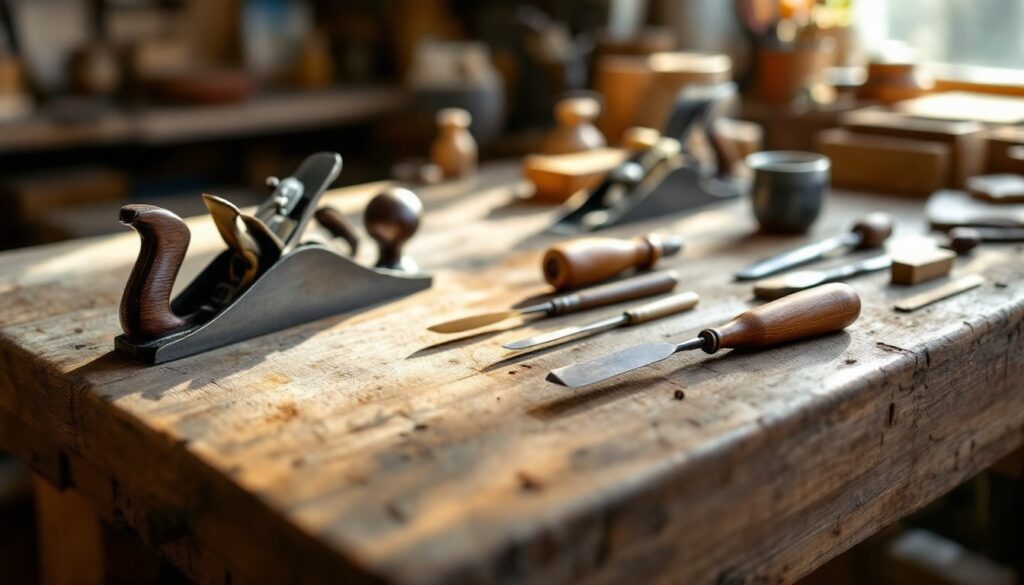
Bench planes anchor most collections. The Stanley Bailey series, particularly the No. 4 smoother, No. 5 jack plane, and No. 7 jointer, are workhorses that still function in modern shops. Pre-WWII models with Sweetheart logos (1920s–1935) feature thicker castings and better quality control than later production.
For serious collectors, infill planes represent the pinnacle. Norris, Spiers, and Mathieson made dovetailed steel bodies filled with rosewood or ebony, often weighing 5–7 pounds. These deliver unmatched precision for smoothing figured hardwoods. Expect prices from $400 to over $2,000 depending on condition.
Molding planes are where things get specialized. Wooden planes from the 1700s and 1800s often bear maker stamps from regional craftsmen. Profiles include beads, ogees, hollows, rounds, and complex multi-plane sets for crown molding. A matched set in good condition can run $500–$1,500. Single planes with common profiles might cost $20–$60.
Transitional planes, metal soles with wooden bodies, bridge eras and attract niche collectors. Stanley made dozens of models between 1870 and 1918. They’re less expensive than full metal or full wooden planes but historically significant.
Vintage Chisels and Gouges
Socket chisels from Witherby, Stanley, or Buck Brothers feature high-carbon steel that takes a finer edge than many modern alternatives. Look for oval bolsters, maker etchings, and handles in boxwood or beech. A set of six pre-1950 chisels in 1/4-inch to 1-inch widths can sell for $100–$300 if edges are clean and handles intact.
Mortise chisels with thick, square-edged blades (often 3/8-inch to 1/2-inch thick) were designed for chopping deep joints. Pig-sticker styles, extra-long blades for timber framing, are rare and collectible.
Carving gouges and V-tools from Swiss, German, and English makers (like Addis or Herring Bros.) feature laminated steel: a hard edge welded to a softer back for shock resistance. Sizes range from 2mm to 40mm sweeps. Full sets in wooden rolls command premium prices, especially if the steel shows minimal wear.
Many vintage chisels outperform budget modern options. As discussed in guides on essential carpenter tools, steel quality and blade geometry often matter more than brand hype.
How to Identify Authentic Antique Woodworking Tools
Fakes and reproductions flood the market. Authentication requires attention to detail.
Examine maker’s marks carefully. Genuine stamps are crisp, evenly struck, and period-appropriate. Stanley, for example, changed logo styles over decades. Pre-1920 tools often show “Stanley Rule & Level Co.” instead of just “Stanley.” Patent dates stamped on castings should match known records. Cross-reference marks with catalogs from This Old House or antique tool databases.
Check casting quality and machining. Early tools have thicker castings with subtle irregularities, hand-finished surfaces, file marks, and slight asymmetry. Modern reproductions often show uniform CNC machining or overly crisp edges.
Inspect metal patina and wear. Natural oxidation appears uneven, concentrated in recesses and around moving parts. Artificial aging often looks too uniform. Genuine wear shows where hands gripped, where blades adjusted, and where parts rubbed during use. Rust should be surface-level and flaky, not deep pitting (unless the tool saw hard neglect).
Look for replacement parts. Swapped blades, handles, or hardware reduce value unless they’re period-correct replacements. Mismatched screws, modern Phillips heads, or inconsistent finishes signal Frankensteining.
Verify wood species and joinery. Antique wooden planes used beech, birch, or fruitwoods. Wedges fit snugly into hand-cut mortises. Machine-made reproductions show router marks and perfect symmetry.
Research model numbers and production dates. Stanley alone made over 200 plane models. Knowing that a No. 1 plane was rare even when new (and commands $1,000+ today) prevents overpaying for a common No. 4 misrepresented as rare.
When building knowledge about workshop tools and equipment, many collectors start by studying manufacturer catalogs, patent records, and auction results to develop an eye for authenticity.
Restoring and Maintaining Antique Woodworking Tools
Restoration philosophy splits collectors. Purists prefer minimal intervention: users want full functionality. Both camps agree on certain principles.
Cleaning starts gently. For surface rust, soak parts in white vinegar or Evapo-Rust (a non-acidic rust remover). Avoid wire wheels or aggressive abrasives that remove original finish and stampings. Brass brushes and 0000 steel wool work for stubborn spots without gouging.
Disassemble carefully. Frozen screws need penetrating oil (PB Blaster or Liquid Wrench) and patience. Heating with a soldering iron can break old lacquer bonds. Don’t force, sheared screws kill value.
Flatten soles and backs. For planes and chisels, flatness is critical. Use a machinist’s straight edge to check. Lapping on 220-grit wet/dry sandpaper on a glass plate removes high spots. Progress through 400, 600, 1000-grit for final polish. This is tedious but necessary for performance.
Sharpen blades correctly. Antique steel often contains higher carbon than modern alloys. Grind at 25–30 degrees for bench planes, 20–25 degrees for paring chisels. Use water stones or diamond plates, avoid overheating on grinding wheels. A micro-bevel at 30–32 degrees extends edge life.
Handle replacement or repair depends on damage. Cracked handles can be stabilized with thin cyanoacrylate (CA glue). If replacement is necessary, match species and shape to original patterns. Avoid using modern handles on antique bodies, it’s like putting LEDs in a vintage lamp.
Protect with wax, not oil. Paste wax (Johnson’s or Renaissance Wax) protects metal without attracting dust. Avoid motor oil or WD-40 on wooden parts, they darken and soften wood over time.
Storage matters. Keep tools in a climate-controlled space. Humidity swings cause rust and wood movement. Tool chests, rolls, or wall racks keep edges safe. Silica gel packs in drawers control moisture.
For those expanding hand tool collections, understanding maintenance preserves both function and investment value.
Where to Find and Buy Antique Woodworking Tools
Sourcing antique tools requires strategy, patience, and skepticism.
Estate sales and auctions often yield the best finds. Tools from a lifetime craftsman’s estate usually include quality pieces at fair prices. Regional auction houses (both live and online) attract less competition than national platforms. Check AuctionZip, LiveAuctioneers, and local listings.
Antique stores and flea markets require digging. Sellers often misprice tools, either too high (assuming age equals value) or too low (unaware of maker significance). Bring a small straight edge, magnet, and flashlight to inspect on-site.
Online marketplaces, eBay, Etsy, Craigslist, Facebook Marketplace, offer volume but demand careful vetting. Request detailed photos of maker marks, sole flatness, and blade condition. Factor in shipping costs (planes are heavy). Avoid “refurbished” listings unless restoration work is documented.
Specialty dealers like Patrick Leach’s Blood and Gore (online catalog), The Best Things, and Hyperkitten (eBay seller) have reputations to protect and price accordingly. You’ll pay more but get accurately described tools and return options.
Tool swaps and club meets, organizations like the Mid-West Tool Collectors Association (M-WTCA) host events where members buy, sell, and trade. These gatherings offer networking and education alongside shopping. Many experienced collectors share knowledge freely, which helps beginners avoid expensive mistakes.
Garage sales and barn cleanouts occasionally turn up treasures. The key is showing up early and knowing what to look for. Bring cash, negotiation works better with bills in hand.
Online communities, forums like WoodNet, Sawmill Creek, and subreddit r/handtools, sometimes have classified sections. Members often sell duplicates from their collections at fair prices to fellow enthusiasts.
Pricing varies wildly by region and condition. A Stanley No. 4 might cost $25 at a yard sale or $150 restored from a specialist. Rare models like a Stanley No. 1 or Norris A5 can exceed $1,000. Sites like Family Handyman and Fix This Build That occasionally feature guides on tool valuation and collecting strategies.
For budget-conscious collectors, watching hand tool deals and setting alerts for specific models increases chances of snagging undervalued pieces. Building relationships with local dealers can also yield early access to incoming inventory.
Verify return policies before buying. Reputable sellers allow returns if items are misrepresented. Avoid “as-is, no returns” deals unless the price reflects the risk. Collecting antique tools combines history, craftsmanship, and function, but only when purchases are informed and intentional.