
Table of Contents
ToggleMilwaukee’s Packout system has become the go-to modular storage solution for anyone serious about keeping their tools organized and mobile. Whether someone’s running a renovation business or building furniture in the garage, this stack-and-lock system promises to end the chaos of scattered drill bits, lost fasteners, and half-empty tool bags. With dozens of compatible boxes, organizers, and accessories that snap together, it’s designed to scale with any workflow, from weekend warriors tackling deck repairs to contractors hauling gear between job sites every day.
Key Takeaways
- Milwaukee Packout tools offer a modular, stack-and-lock storage system with over 50 compatible products designed to keep tools organized, portable, and weather-sealed on job sites or in home workshops.
- The impact-resistant polymer construction with IP65 weather sealing and metal latches protects tools from dust, moisture, and temperature changes, making the Packout system ideal for both indoor and outdoor projects.
- DIYers can start with a rolling toolbox and one organizer, then customize their setup by grouping tools by task (rather than type) and adding boxes as their tool collection and project needs grow over time.
- Organizing Packout boxes with task-specific kits—such as dedicated drywall, plumbing, or finish carpentry setups—saves time by keeping everything needed for a project in one place without searching through general toolboxes.
- Wall-mounted Packout plates free up floor space, extend box lifespan by keeping them off damp garage floors, and provide quick access to frequently used items without unstacking the entire tower.
- Quarterly reviews and reorganization ensure the Packout system remains efficient as project types change, with the modular design making it easy to swap organizers and retire boxes no longer in use.
What Is the Milwaukee Packout System?
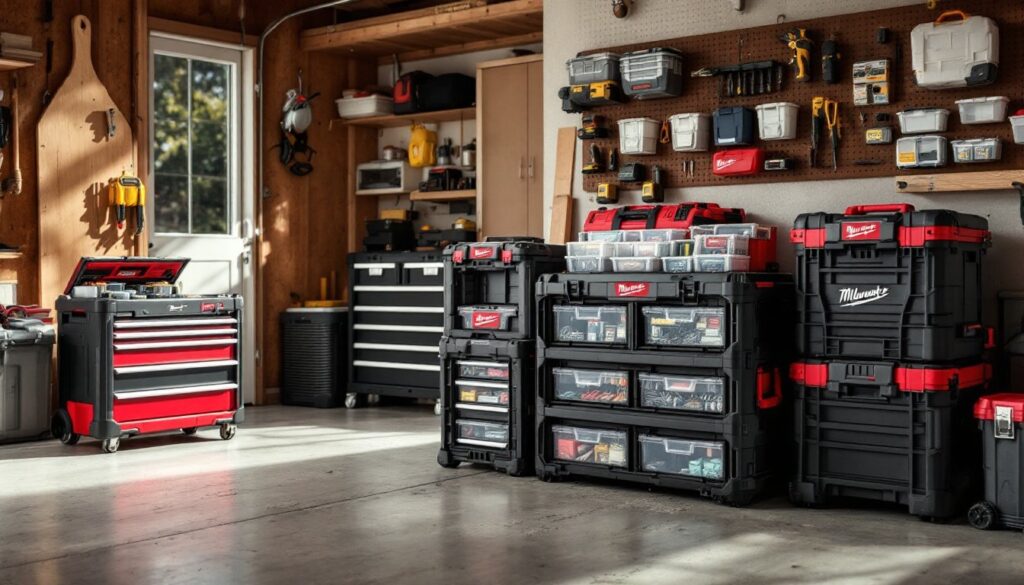
The Packout system is Milwaukee’s line of impact-resistant, modular storage containers that connect using a locking cleat mechanism. Each box, whether it’s a rolling toolbox, compact organizer, or specialty case, features metal reinforced corners and an IP65-rated weather seal to keep contents dry on job sites or in truck beds.
The key advantage is interchangeability. A user can stack a large rolling toolbox on the bottom, add a mid-sized tool box in the middle, and top it off with a compact organizer for hardware, all locked together with metal latches. The entire stack moves as one unit on heavy-duty wheels.
Cases are made from high-impact polymer that handles drops, UV exposure, and temperature swings. Metal tie-downs on top let users strap down additional gear or mount accessories like cup holders and drill holsters. The system also includes wall-mount plates, allowing someone to hang boxes in their workshop for quick access without hauling the full stack.
Milwaukee offers over 50 Packout products, including foam-insert totes, drawers, backpacks, and even a rolling tool chest that doubles as a mobile workbench. Everything uses the same cleat pattern, so older and newer models remain compatible.
Why Milwaukee Packout Is Perfect for Home Workshops and DIY Projects
Most home workshops suffer from one problem: tools spread across benches, shelves, pegboards, and random plastic bins that crack after a year. The Packout system solves this by consolidating everything into a portable, weatherproof setup that doesn’t require a permanent footprint.
For DIYers working on multiple projects, say, installing trim one weekend and building raised garden beds the next, being able to grab a pre-loaded stack saves time. A trim carpentry setup might include a Packout rolling box with a miter saw, a mid-box with a finish nailer and compressor hoses, and a compact organizer for brad nails and wood filler. Next weekend, swap in a different mid-box loaded with drill drivers and Forstner bits for the garden project.
The modular design also suits renters or anyone without a dedicated garage. Stack the system in a closet or corner, wheel it out when needed, and return it when done. No need for built-in cabinets or wall-mounted pegboards that won’t follow when moving.
Durability matters for home improvement projects that involve dust, moisture, and temperature changes. The IP65 seal keeps out jobsite grit and light rain, which is useful when working on outdoor decks, siding repairs, or unheated garages in winter. Metal latches won’t pop open if someone accidentally kicks the stack, unlike cheaper plastic storage that uses friction clips.
Another benefit: scalability without waste. Someone starting with hand tools can begin with a single organizer and rolling base, then add boxes as their tool collection grows. There’s no need to replace the entire storage system when upgrading from basic DIY to more advanced projects like cabinet-making or electrical work.
Essential Milwaukee Packout Tools and Components to Start With
Building a Packout setup doesn’t require buying everything at once. Start with a foundation and add components based on the types of projects someone tackles most often.
Tool Boxes and Rolling Cases
The Packout rolling toolbox (22 inches) serves as the base for most setups. It features 7-inch wheels that handle job site debris, gravel driveways, and workshop floors without getting stuck. Internal volume is roughly 35 liters, enough for larger power tools like circular saws, reciprocating saws, or a portable table saw.
For mid-level storage, the large toolbox (also 22 inches but shallower) fits drills, impact drivers, sanders, and their batteries. It includes a removable tray for bits and blades. The compact toolbox works well for hand tools, tape measures, levels, hammers, chisels, and utility knives.
Anyone hauling heavy gear should consider the Packout rolling tool chest. It has three drawers with ball-bearing slides rated for 100 pounds per drawer. The top surface doubles as a mobile workstation with a built-in power tool holder. This setup suits workshop organization for woodworkers who need quick access to routers, biscuit joiners, and bench planes.
Organizers and Small Parts Storage
The Packout compact organizer features 10 removable bins, ideal for screws, anchors, wire nuts, or finish nails. Bins are clear plastic, so someone can identify contents without opening every lid. This organizer stacks on top of larger boxes and keeps small parts from migrating to the bottom of a toolbox.
For even finer sorting, the low-profile organizer has adjustable dividers. It’s shallow enough to fit under a truck seat but deep enough for drill bits, driver bits, hole saws, and spade bits. Pros often use this for fastener kits organized by size and material, deck screws, drywall screws, lag bolts, etc.
The three-drawer unit adds intermediate storage for items that don’t need a full toolbox. Each drawer locks independently and can hold batteries, chargers, cords, or consumables like sandpaper and painter’s tape. It’s also useful for electrical work, wire strippers, voltage testers, connectors, and junction boxes fit neatly without rattling around.
Milwaukee also makes specialty organizers, including one with a foam insert for impact sockets. The foam is pre-cut for metric and SAE sizes, keeping each socket visible and preventing loss. This is especially helpful for automotive or HVAC work where missing a 10mm socket can derail a project.
How to Customize Your Packout Setup for Maximum Efficiency
The real power of Packout comes from tailoring it to specific workflows. Off-the-shelf configurations work, but custom setups save time and reduce frustration on every project.
Start by grouping tools by task, not by type. Instead of one box for all drills and another for all drivers, create task-specific kits. A drywall kit might include a screw gun, drywall saw, taping knife, mud pan, and sanding block, all in one mid-sized box with an organizer for screws and anchors. A plumbing kit could hold a pipe wrench, basin wrench, tube cutter, PEX crimper, and fittings organizer. This way, someone grabs the right box and has everything needed without digging through a general toolbox.
Use foam inserts for fragile or expensive tools. Milwaukee sells blank foam sheets that fit inside Packout boxes. Trace the outline of a router, biscuit joiner, or oscillating multitool, then cut the foam with a utility knife or hot wire cutter. Custom foam prevents tools from shifting during transport, which is critical for calibrated equipment like laser levels or precision measuring tools.
Mount wall plates in the workshop. The Packout wall plate system lets someone hang boxes vertically, freeing up floor space and making it easy to grab a single organizer without unstacking the entire tower. Mount plates at eye level for frequently used items, driver bits, pencils, chalk lines, and higher for seasonal gear like gutter cleaning tools or holiday light installation kits. Wall mounting also keeps boxes off damp garage floors, extending their lifespan.
Label everything. Even with clear bins, labeling prevents wasted time. Use a label maker or permanent marker on masking tape. For boxes with similar contents (two organizers full of different screw types), color-coded labels help, red for exterior screws, blue for interior, yellow for specialty fasteners.
Add accessories as needed. Milwaukee makes Packout-compatible accessories like a crate for lumber offcuts, a tech bag for meters and testers, and a cooler (yes, really, useful for keeping drinks cold during long deck builds or concrete pours). There’s also a Packout light that mounts on top of the stack for working in unlit basements or attics.
For pros or serious DIYers, the Packout drawer unit (48 inches wide) mounts to a truck bed or workshop wall. It holds multiple stacks and provides a central hub for all tools. Combined with smaller mobile stacks, this creates a base camp approach, main storage stays stationary, but custom kits go to the job.
Review and reorganize quarterly. As projects change, so do tool needs. Someone focusing on finish carpentry won’t need the same setup as someone doing rough framing or electrical rough-ins. Swap organizers, rearrange stacks, and retire boxes that no longer serve a purpose. The modular design makes this easy, no need to rebuild an entire storage wall.
Conclusion
Milwaukee’s Packout system has earned recognition in tool innovation awards for good reason, it solves real storage problems without requiring a custom-built shop. Whether someone’s organizing a single-car garage or outfitting a mobile workshop, the system scales, adapts, and lasts. Start with a rolling base and one organizer, then build from there as projects demand.