
Table of Contents
ToggleMilwaukee’s cordless tool ecosystem has become a staple in workshops and job sites across North America, and the batteries powering these tools are the backbone of that system. Whether you’re framing walls, drilling overhead, or running a circular saw through hardwood, understanding the differences between battery platforms, capacity ratings, and performance characteristics can mean the difference between finishing a project or scrambling for a charger. Milwaukee offers two distinct battery systems, M12 and M18, each designed for different use cases, plus multiple capacity options within each platform. This guide breaks down what you need to know to match the right battery to your tools and workflow, maximize runtime, and avoid common pitfalls that drain battery life.
Key Takeaways
- Milwaukee tools batteries come in two platforms—M12 (12V) for light-duty tasks like cabinet work and trim carpentry, and M18 (18V) for heavy-duty applications like circular saws and impact wrenches, with no cross-compatibility between systems.
- Choose battery capacity based on your tool’s power demands: compact 1.5Ah–3.0Ah batteries prioritize portability for light work, while High Output and High Demand batteries (6.0Ah–12.0Ah) deliver extended runtime for demanding tools that run continuously.
- Maximize Milwaukee tools battery lifespan by avoiding deep discharges, storing packs at 40–60% charge in cool conditions, matching battery capacity to tool demand, and keeping terminals clean to prevent power loss.
- An M18 battery labeled ’18V’ actually measures around 20V at full charge, and any capacity M12 or M18 battery works with any tool on its respective platform, regardless of age or generation.
- Heavy-duty tasks like cutting hardwood, running miter saws, or working in locations without AC power require High Demand batteries that use upgraded 21700 lithium-ion cells for sustained current delivery without overheating.
Understanding Milwaukee’s M12 and M18 Battery Systems
Milwaukee’s cordless lineup is split into two voltage platforms: M12 (12V) and M18 (18V). These aren’t interchangeable, each system uses a unique battery mounting design and voltage output.
The M12 system targets compact, light-duty applications where space and weight matter. Think trim carpentry, HVAC installation, automotive work, or overhead drilling. M12 batteries use lithium-ion cells and come in capacities ranging from 1.5Ah to 6.0Ah. The smaller form factor makes tools like the M12 Fuel oscillating multi-tool or the M12 3/8″ ratchet easier to maneuver in tight spaces. If you’re installing cabinet hardware or assembling furniture, M12 tools won’t fatigue your wrist after an hour.
The M18 system is Milwaukee’s heavy-duty platform, powering everything from circular saws and impact wrenches to miter saws and even battery-powered table saws. M18 batteries range from 1.5Ah to 12.0Ah High Demand (HD) models. The voltage difference gives M18 tools more torque and sustained power under load, critical when you’re cutting through 2×10 joists or driving 3-inch screws into framing lumber.
One key detail: Milwaukee uses nominal voltage labeling. An “18V” M18 battery actually measures around 20V at full charge (similar to other brands’ 20V Max systems). It’s a marketing difference, not a performance gap.
Compatibility within each system is excellent. Any M18 battery fits any M18 tool, and any M12 battery fits any M12 tool. There’s no proprietary lockout based on age or capacity, a first-generation M18 drill from 2008 will run on a brand-new 2026 12.0Ah HD battery, though the older tool won’t take full advantage of the power delivery improvements.
That said, using a low-capacity battery on a high-draw tool (like pairing a 2.0Ah pack with a 7-1/4″ circular saw) will result in short runtime and potential battery strain. Match capacity to the tool’s demand for best results.
Choosing the Right Battery Capacity for Your Projects
Battery capacity, measured in amp-hours (Ah), dictates how long a tool runs before needing a recharge. But capacity isn’t the only factor, battery chemistry, cell configuration, and the tool’s power draw all play a role. Here’s how to match capacity to your work.
Compact Batteries for Light-Duty Tasks
For jobs that prioritize portability and balance over runtime, compact batteries (1.5Ah to 3.0Ah for M18, 1.5Ah to 2.0Ah for M12) make sense. These packs reduce tool weight and bulk, which matters when you’re working overhead or in confined areas.
Use compact M18 batteries for:
- Driving screws with an impact driver during cabinet installation or deck framing
- Drilling pilot holes with a 1/2″ drill/driver
- Light cutting with an oscillating multi-tool or jigsaw
Use compact M12 batteries for:
- Installing outlet boxes or running low-voltage wiring
- Automotive repairs with ratchets or 3/8″ impact wrenches
- Detail sanding or caulking with powered applicators
The tradeoff is runtime. A 2.0Ah M18 battery might give you 30–50 minutes of intermittent drilling, but only 10–15 minutes of continuous circular saw use. If you’re working solo and can swap batteries during breaks, compact packs keep tools nimble. If you’re on a ladder or can’t easily access a charger, step up in capacity.
High-Output Batteries for Demanding Applications
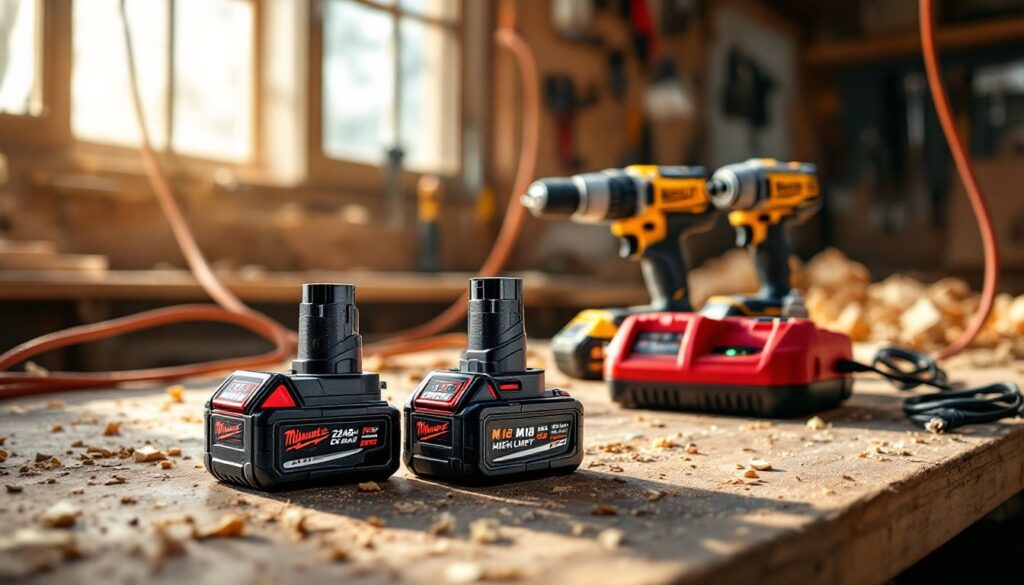
Milwaukee’s High Output (HO) and High Demand (HD) batteries use upgraded cell chemistry (21700 lithium-ion cells instead of older 18650 cells) to deliver more current without overheating. These packs are essential for tools that draw heavy, sustained loads.
The 6.0Ah High Output battery is the sweet spot for most pros and serious DIYers. It balances runtime and weight across the M18 lineup, providing:
- 400–600 cuts in 2×4 framing lumber with a 7-1/4″ circular saw
- 60–90 minutes of continuous sanding with a random orbital sander
- All-day runtime for impact drivers and drills in typical residential framing
The 8.0Ah and 12.0Ah HD batteries are built for the most power-hungry tools. Milwaukee’s HD12.0 battery, introduced in recent years, can run a table saw or chainsaw on battery power alone, eliminating extension cords on remote job sites. According to coverage from Popular Mechanics, the HD12.0 delivers up to 33% more runtime than the HD9.0 on high-draw tools.
Use HO/HD batteries when:
- Running miter saws, reciprocating saws, or angle grinders for extended periods
- Cutting hardwood, engineered lumber, or thick stock where the tool bogs under load
- Working in locations without AC power (remote sites, outdoor decks, attics)
One note: larger batteries add noticeable weight. A 12.0Ah HD pack weighs about 2.5 pounds, nearly double a 2.0Ah compact. On a drill or impact driver, that shifts the tool’s balance point rearward. It’s not a problem for stationary work, but overhead drilling for an hour with a heavy battery will fatigue your arm.
How to Maximize Battery Life and Performance
Lithium-ion batteries degrade over time, but how you charge, store, and use them dramatically affects lifespan. Follow these practices to get the most cycles out of your Milwaukee packs.
Avoid deep discharges. Lithium-ion cells last longer when kept between 20% and 80% charge. Running a battery until the tool shuts off (complete discharge) stresses the cells. If you’re doing production work, rotate two or three batteries rather than draining one to zero repeatedly. Milwaukee’s fuel gauge (the LED indicator on the battery) helps you monitor charge, swap packs when you hit one or two bars remaining.
Store batteries at partial charge. If you’re not using a battery for weeks or months, store it at around 40–60% charge in a cool, dry location. A fully charged battery sitting idle for months will lose capacity faster than one stored partially charged. Extreme heat accelerates degradation, don’t leave batteries in a vehicle during summer or next to a furnace in winter.
Use the right charger. Milwaukee offers standard chargers, Rapid Chargers, and Super Chargers. Rapid and Super Chargers cut charge times significantly (a 6.0Ah battery charges in about 60 minutes on a Rapid Charger vs. 120+ minutes on a standard charger), but faster charging generates more heat. For everyday use, rapid charging is fine. For long-term battery health, standard chargers are gentler.
Match battery capacity to tool demand. As noted earlier, pairing a small battery with a high-draw tool forces the cells to work harder, generating heat and reducing cycle life. Similarly, using a 12.0Ah HD battery on a low-draw tool like a work light is overkill, you’re carrying extra weight for no runtime benefit.
Keep contacts clean. Sawdust, drywall dust, and metal shavings can accumulate on battery terminals, increasing resistance and causing poor contact. Wipe terminals with a dry cloth periodically. Avoid using solvents or abrasives, just a clean rag.
Monitor for recalls and firmware updates. While rare, battery recalls happen. Milwaukee occasionally issues safety notices for specific production runs. Register your batteries at Milwaukee’s website to receive alerts. Some newer Milwaukee tools have onboard diagnostics that optimize battery communication, keeping tools and chargers updated (when applicable) ensures best performance.
Finally, invest in quality storage. If you’ve accumulated multiple batteries, consider a wall-mounted charging station or a tool chest with dedicated battery slots. Batteries rolling around loose in a truck bed or toolbox risk physical damage to the casing and terminals. A cracked battery case can expose cells to moisture, leading to failure or, in extreme cases, thermal events.
For additional project ideas and tool maintenance tips, resources like Bob Vila and Family Handyman offer practical guides that complement hands-on battery care.
One last tip: if you’re expanding your Milwaukee collection and looking to save on foundational gear, keeping an eye on hand tool deals can free up budget for higher-capacity batteries or additional chargers.
Conclusion
Milwaukee’s M12 and M18 battery systems offer flexibility and power across a huge range of applications. By understanding the differences between compact and high-capacity packs, matching battery size to tool demand, and following best practices for charging and storage, you’ll get years of reliable performance from your investment. Choose batteries based on the work you do most, not just the highest capacity, and rotate packs to spread wear evenly.