
Table of Contents
ToggleMilwaukee drills have earned their red-and-black stripes in garages, job sites, and workshops across the country. But walk into any home center and you’ll face a wall of M12s, M18s, Fuel models, and compact drivers, each claiming to be the perfect fit. The difference between a drill that handles weekend projects and one that tackles serious renovation work comes down to understanding battery platforms, torque ratings, and whether you actually need a hammer function. This guide cuts through the marketing noise to help homeowners pick the Milwaukee drill that matches their project list and skill level.
Key Takeaways
- Milwaukee drills stand out in the power tool market due to brushless motors, metal gear housings, and REDLITHIUM batteries that maintain charge better in cold weather than competitors.
- Choose between M12 Fuel for lightweight overhead work, M18 for general DIY projects, or M18 Fuel hammer drills when tackling masonry and concrete applications.
- Battery platform selection locks you into an ecosystem—M18 tools offer over 250 product options compared to 100 M12 models, making it the better choice for most homeowners starting from scratch.
- Clutch settings on Milwaukee drill/drivers prevent over-torquing screws and stripping fasteners; match the setting to your material, using lower positions for trim screws and higher positions for structural fasteners.
- Invest in quality bits like Milwaukee’s Shockwave Impact Duty line and match battery capacity to your project—compact 2.0Ah batteries for quick tasks and 5.0Ah or 6.0Ah for extended projects.
Why Milwaukee Drills Stand Out in the Power Tool Market
Milwaukee Tool built its reputation in industrial and trade applications before dominating the prosumer space. That heritage shows in build quality, metal gear housings instead of plastic, rubberized grips that survive drops, and brushless motors that outlast cheaper alternatives by years.
The M12 and M18 battery platforms deserve special attention. Once you buy into one system, every subsequent tool shares the same batteries and chargers. An M18 battery powers everything from drills to blowers to shop vacs, eliminating the drawer full of incompatible chargers that plague multi-brand tool collections.
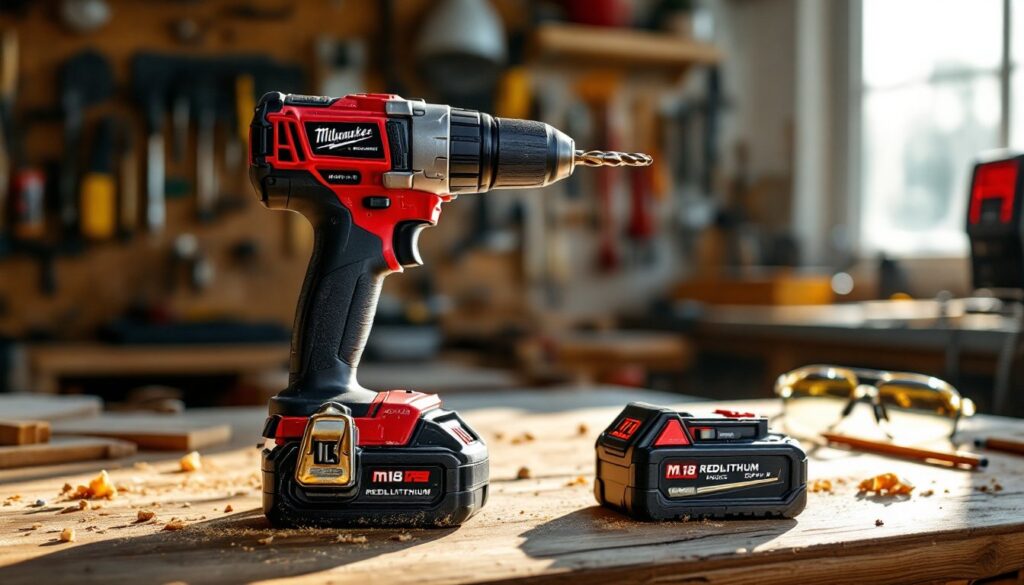
Milwaukee’s REDLITHIUM batteries use proprietary cell chemistry and circuit board protection that prevents overheating and extends runtime. In field tests, these batteries maintain charge through cold weather better than competitors, crucial for anyone working in an unheated garage during winter months.
The Fuel line takes performance further with brushless motors that adjust power delivery based on resistance. When drilling through oak versus pine, a Fuel drill modulates torque automatically, reducing strip-outs and extending bit life. That intelligence matters when precision counts more than brute force.
Types of Milwaukee Drills: Finding Your Perfect Match
Milwaukee produces three main drill categories, each engineered for specific materials and applications.
Drill/Drivers for Everyday DIY Projects
Drill/drivers handle 90% of what homeowners encounter: assembling furniture, installing shelving brackets, building deck frames, and hanging cabinets. These tools combine a keyless chuck (typically ½-inch capacity) with variable speed triggers and adjustable clutches that prevent over-torquing screws.
The clutch settings (usually 15-20 positions plus drill mode) let users dial in exact torque for driving trim screws into hardwood without snapping heads. Set it to position 5 for drywall, crank it to 18 for lag bolts into framing lumber.
Milwaukee’s compact drill/drivers like the 2801-20 measure under 7 inches long, fitting into tight spaces like cabinet interiors or between wall studs. The trade-off? Lower torque output, around 500 inch-pounds compared to 1,200+ on full-size models. For most home projects, that’s plenty.
Hammer Drills for Masonry and Tough Materials
Hammer drills add a percussive forward motion, thousands of tiny impacts per minute, that pulverizes concrete, brick, and block as the bit rotates. When anchoring ledger boards to foundation walls or installing tapcons for deck posts, a standard drill just overheats and dulls bits. Hammer function makes the job possible, not just easier.
The hammer mechanism engages via a selector switch. Use standard drill mode for wood and metal, switch to hammer mode when the bit hits concrete. Quality models like the Milwaukee 2804-20 deliver up to 32,000 BPM (blows per minute) while maintaining 1,200 inch-pounds of torque.
One heads-up: hammer drills cost $40-80 more than equivalent drill/drivers. Homeowners planning bathroom remodels, basement finishing, or exterior projects involving masonry should budget for hammer function. Those sticking to framing, trim, and furniture work can skip it and invest savings in better bits and accessories.
Top Milwaukee Drill Models for Homeowners in 2026
Three models cover the spectrum from light-duty assembly to serious renovation work.
The M12 Fuel 2504-20 runs on Milwaukee’s 12-volt platform, balancing power and portability for users who don’t regularly drill into dense hardwoods or thick steel. At 5.9 inches head length and under 2 pounds with a compact battery, it excels at overhead work, think installing ceiling fans or running conduit in crawlspaces. The 350 inch-pound torque handles cabinet installation and general repairs without the wrist fatigue of heavier 18-volt models. Contractors often carry this as a second drill for finish work.
The M18 2801-20 drill/driver represents the sweet spot for most DIYers. It delivers 500 inch-pounds in a package that won’t expensive or your wrist. The ½-inch chuck accepts standard bits, and the 15-position clutch prevents over-driving screws in softwoods. Pair it with a 5.0Ah battery and expect 60-80 screws per charge in framing lumber. This model appears in most hand tool deals during holiday sales, often bundled with an impact driver.
For users tackling foundation work, tile removal, or regular masonry drilling, the M18 Fuel 2904-20 hammer drill justifies the premium. After extensive real-world testing documented by Popular Mechanics, this model proved its durability across thousands of holes in concrete and brick. The brushless motor, metal gear housing, and 1,200 inch-pounds of torque handle everything from ¼-inch pilot holes to ½-inch masonry anchors. The hammer function disengages completely when not needed, so it doubles as a premium drill/driver.
Key Features to Consider Before Buying
Torque ratings get advertised heavily but matter less than how they’re delivered. A drill with 1,200 inch-pounds sounds impressive until you realize it only hits that number in gear one at maximum speed. Check torque specs across both gear ranges, most drills offer a high-torque/low-speed gear for driving and a low-torque/high-speed gear for drilling.
Chuck type determines bit compatibility and change speed. Keyless chucks (standard on all modern Milwaukee drills) accept round and hex-shank bits up to the rated capacity, typically ½-inch. Single-sleeve chucks tighten with one hand: two-sleeve designs require both hands but grip harder. For home use, single-sleeve works fine.
Battery platform locks you into an ecosystem. M12 tools cost less and weigh less but deliver lower power. M18 tools handle heavier work and offer a broader tool selection, Milwaukee makes over 250 M18 products versus roughly 100 M12 options. Homeowners starting from scratch should choose M18 unless portability trumps all other concerns.
Brushless vs. brushed motors affect longevity and efficiency. Brushless motors (found in Fuel models) eliminate the carbon brushes that wear out in traditional motors. They run cooler, deliver more torque per watt, and typically last 3-5 times longer. The upcharge, usually $50-80, pays off if you plan to keep the tool beyond occasional use.
LED work lights seem like a gimmick until you’re drilling into a dark cabinet base or basement rim joist. Milwaukee positions LEDs near the chuck to illuminate the work surface. Better models include lights that stay on for 10-15 seconds after releasing the trigger.
Belt clips and bit storage matter for workflow. A good belt clip (preferably reversible for left- or right-side carry) keeps the drill accessible when moving between tasks. Some models include bit holders in the battery base, handy for phillips and square drives during assembly projects.
Tips for Getting the Most Out of Your Milwaukee Drill
Invest in quality bits. A $200 drill deserves better than the $9 mixed bit set from the checkout aisle. Milwaukee’s Shockwave Impact Duty bits feature reinforced shanks and heat-treated tips that survive the torque these drills produce. For wood, Irwin Speedbor bits cut clean holes in framing lumber. For metal, cobalt or titanium-coated twist bits hold edges longer than standard high-speed steel.
Match battery capacity to the task. Compact 2.0Ah batteries keep the drill lightweight for overhead work and quick tasks. Use 5.0Ah or 6.0Ah batteries for extended projects like building a deck or framing a partition wall. The larger batteries add weight but eliminate mid-project recharges. Many experienced DIYers keep one battery charging while using another, rapid chargers refill a 5.0Ah pack in under an hour.
Use the clutch settings. Most stripped screws happen because users leave the drill in drill mode when driving fasteners. Set the clutch to a lower number for trim screws, increase it for structural fasteners. If the clutch slips before the screw seats, bump up one setting at a time. This habit prevents countersinking screw heads into drywall and splitting trim boards.
Keep the chuck clean and tight. Sawdust and metal shavings migrate into the chuck jaws, preventing proper bit grip. After dusty jobs, open the chuck fully and blow it out with compressed air. Every few months, tighten the chuck by hand to ensure the jaws close evenly. A loose chuck lets bits slip under torque, ruining both the bit and the fastener.
Store batteries properly. REDLITHIUM batteries maintain charge for months but perform best when stored between 40-70% capacity. If storing a drill for winter, charge batteries to half-full and keep them in a climate-controlled space, not the garage where temperatures swing from freezing to 100°F. Cold batteries deliver reduced runtime: hot batteries degrade faster. Resources like This Old House and Family Handyman regularly publish maintenance guides for power tool care.
Wear appropriate PPE. Safety glasses protect against metal shavings when drilling steel or masonry dust when using hammer mode. Hearing protection matters during extended drilling sessions, hammer drills generate 90+ decibels. Dust masks or respirators become necessary when drilling treated lumber, MDF, or concrete. These aren’t suggestions for job sites: they apply equally to home workshops.