
Table of Contents
ToggleIf you’ve ever stood in the tool aisle trying to decode the fine print on a DeWalt package, you’re not alone. The “Made in USA” question isn’t as straightforward as it used to be. DeWalt’s yellow and black cases sit on shelves next to imports, domestics, and everything in between, and the branding doesn’t always tell the whole story. Some DeWalt tools roll off assembly lines in the States, others come from Mexico, China, the Czech Republic, or Brazil. For DIYers and homeowners who care about sourcing, quality, or simply supporting domestic manufacturing, understanding where your drill or saw actually comes from matters. Here’s what you need to know before your next tool purchase.
Key Takeaways
- DeWalt tools are manufactured across multiple countries including the USA, Mexico, China, the Czech Republic, Brazil, and the UK—so the brand’s logo doesn’t guarantee American-made status.
- Power tools made in the USA primarily include corded models like miter saws, table saws, and planers, while most cordless tools are assembled overseas, particularly in Mexico and China.
- Roughly 60% of DeWalt hand tools sold in North America have US content or final assembly, making hand tools the strongest category for domestic manufacturing.
- Check the fine print on packaging, model number prefixes, and country-of-origin stamps on the tool body itself—not price or appearance—to identify genuine USA-made DeWalt products.
- US-made DeWalt tools offer benefits like faster warranty service and easier parts sourcing, but imported models deliver comparable quality and performance for most homeowner DIY projects.
- For the best balance of values and budget, invest in US-made DeWalt tools for heavy-use items like miter saws and core hand tools, while choosing based on performance and price for occasional-use products.
DeWalt’s Manufacturing Footprint: A Global Operation
DeWalt, owned by Stanley Black & Decker since 1960, operates manufacturing facilities across multiple continents. The company maintains seven plants in the United States, primarily in the Southeast and Midwest, alongside dozens of factories in Mexico, China, Brazil, the Czech Republic, Italy, and the UK.
This global network isn’t unusual for major tool brands. DeWalt balances production costs, supply chain logistics, tariffs, and regional demand by distributing manufacturing across different countries. A cordless drill sold in North America might share components from three continents before final assembly.
The brand’s American facilities focus on specific product lines, particularly corded power tools, hand tools, and certain battery platforms, while overseas plants handle high-volume consumer products and specialized equipment for international markets. DeWalt has invested over $100 million in US manufacturing expansion since 2013, adding jobs and production lines in existing facilities rather than building new standalone plants.
Understanding this structure helps explain why two seemingly identical tools might have different country-of-origin stamps. It’s not inconsistency, it’s intentional product segmentation based on manufacturing capabilities and market strategy.
Which DeWalt Tools Are Actually Made in the USA?
Power Tools Manufactured in American Facilities
DeWalt’s US-made power tool lineup centers on corded models and professional-grade equipment. As of 2026, tools produced domestically include:
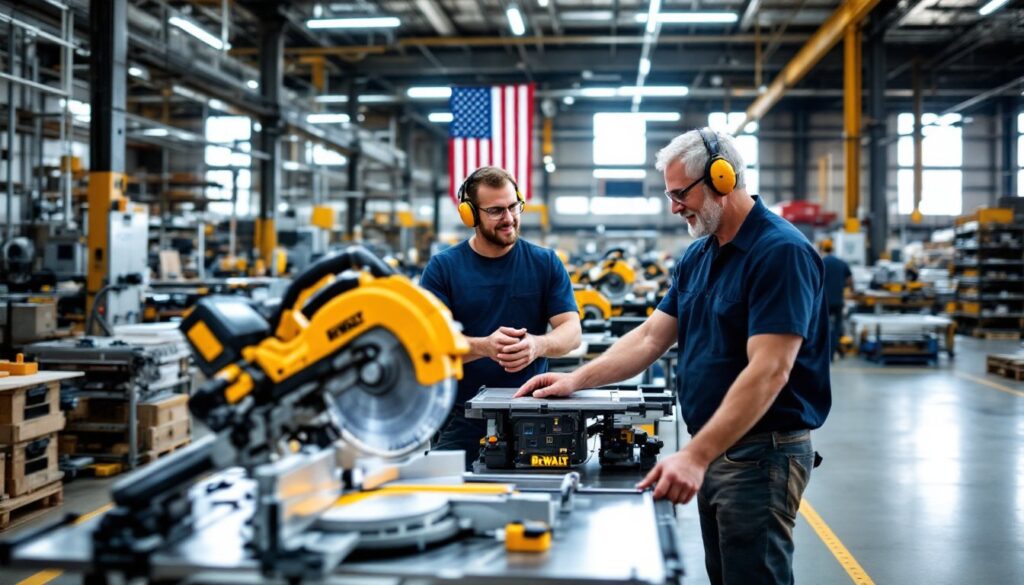
- Miter saws (select models in the DWS779 and DWS780 series)
- Table saws (jobsite models like the DWE7491)
- Planers (the DW735 thickness planer, assembled in South Carolina)
- Grinders and sanders (certain angle grinders and random orbital sanders)
- Rotary hammers (heavy-duty SDS-plus and SDS-max models)
The FLEXVOLT battery system components, including some chargers and battery packs, come from the Charlotte, North Carolina facility. But, many cordless tools themselves, even those using FLEXVOLT batteries, are assembled overseas, primarily in Mexico and China.
Recent testing by Popular Mechanics confirmed that DeWalt’s professional-grade corded circular saws maintain US assembly, while compact jobsite models often carry import stamps. If you’re shopping for American-made power tools, corded options give you better odds than battery-powered equivalents.
Hand Tools and Accessories With US Production
DeWalt’s hand tool production tells a different story. The company manufactures a significant portion of its mechanics’ tools, storage solutions, and accessories in the US:
- Tape measures (select models, including the 25-foot DWHT36225)
- Levels (box beam and torpedo levels from the Hampden, Massachusetts plant)
- Utility knives and blades (certain retractable models)
- Screwdrivers and multi-bit sets (professional-grade lines)
- Socket sets and wrenches (limited SKUs in the mechanics’ tool range)
- ToughSystem storage (some cases and organizers)
Hand tools represent DeWalt’s strongest domestic manufacturing commitment. According to statements from Stanley Black & Decker, roughly 60% of DeWalt-branded hand tools sold in North America have US content or final assembly. That’s a higher percentage than you’ll find in power tools, where global sourcing dominates.
For homeowners building a basic toolkit, focusing on hand tool deals with verified US production offers a practical path to supporting domestic manufacturing without breaking the budget.
How to Identify USA-Made DeWalt Products Before You Buy
Forget relying on the DeWalt logo alone, yellow and black doesn’t mean American-made. You need to check specific locations on the packaging and tool body:
-
Read the fine print on the box: Look for “Made in USA,” “Assembled in USA,” or “Made in USA with global materials.” Each phrase has different implications. “Made in USA” means the tool was substantially transformed domestically. “Assembled in USA” indicates final assembly happened stateside, but major components came from elsewhere.
-
Check the tool body and nameplate: DeWalt stamps country of origin directly on the motor housing, battery compartment, or handle. On cordless drills, check near the battery slot. On miter saws, look at the rear motor housing.
-
Scan the model number prefix: While not foolproof, certain DeWalt model series correlate with manufacturing location. Professional-grade corded tools (often starting with “DW”) have higher US production rates than consumer cordless models (often starting with “DCF” or “DCD”).
-
Use the DeWalt website’s product page: Individual product listings sometimes include country of origin in the specifications tab. It’s inconsistent, but worth checking before you drive to the store.
-
Ask the retailer for the manual or spec sheet: The printed manual inside the box always lists manufacturing location. Big-box stores can usually pull up digital manuals at the service desk.
Safety note: Don’t assume price correlates with domestic production. Some imported DeWalt tools cost more than US-made equivalents due to tariffs, shipping, or feature sets. Price alone won’t tell you where a tool came from.
Why DeWalt Manufactures Tools Overseas (And What It Means for Quality)
DeWalt’s global manufacturing strategy isn’t about cutting corners, it’s about scale, specialization, and cost structure. Here’s the reality:
Labor and overhead costs drive location decisions. Assembling a cordless drill in China or Mexico costs 30-50% less than domestic production, even accounting for shipping. For high-volume consumer tools, that margin determines whether the product hits competitive price points at retail.
Supply chain proximity matters. Lithium-ion battery cells, brushless motor components, and electronic controllers concentrate in Asian manufacturing hubs. Shipping raw components to the US for assembly adds cost and lead time without improving the final product.
Specialized expertise lives in specific facilities. DeWalt’s Czech Republic plant leads in dust extraction systems. The UK facility specializes in corded demolition hammers. Centralized production for complex tools reduces quality variation compared to licensing designs across multiple plants.
Does overseas manufacturing hurt quality? Testing by Good Housekeeping and Bob Vila found no consistent quality difference between US-made and imported DeWalt tools when comparing similar product tiers. A Chinese-made 20V drill performs identically to a US-assembled model if both use the same motor, gearbox, and quality control standards. The issue isn’t where it’s made, it’s whether DeWalt applies consistent standards across facilities.
What does vary: warranty support speed, parts availability, and repair infrastructure. US-made tools sometimes see faster service turnaround because replacement parts stock domestically. For professional contractors, that matters. For weekend warriors, the difference is negligible.
Should US Manufacturing Matter to DIYers and Homeowners?
Whether country of origin should influence your tool purchase depends on what you value and how you use the equipment.
If you prioritize supporting American jobs and domestic manufacturing, focus on DeWalt’s corded power tools, hand tools, and accessories with verified US production. You’ll pay slightly more in some categories, but the price gap has narrowed as DeWalt expanded domestic facilities. For common DIY projects, building a deck, finishing a basement, installing trim, US-made miter saws, planers, and levels handle the work just fine.
If budget drives decisions, don’t artificially limit your options to US-made tools. A homeowner replacing a deck board twice a year doesn’t need to spend extra for domestic assembly. The imported DeWalt cordless drill will outlast your project list. Save the premium for tools you’ll use weekly or loan to neighbors who won’t return them gently.
If quality and warranty matter most, read reviews and check failure rates rather than manufacturing location. DeWalt’s quality control standards apply globally, but individual product lines vary in durability regardless of origin. A well-reviewed Mexican-made impact driver beats a poorly designed US-made model every time.
Consider lifecycle costs: US-made tools often qualify for faster warranty service and easier parts sourcing. If you’re tackling a kitchen remodel and can’t afford downtime waiting for replacement parts shipped from overseas, domestic production offers practical insurance.
For most DIYers and homeowners, the sweet spot is a mixed toolkit: invest in US-made tools for heavy-use categories (miter saw, table saw, core hand tools) and choose based on performance and price for occasional-use items (specialty drivers, niche accessories). That approach balances values, budget, and project needs without overthinking every purchase.
Bottom line: DeWalt makes solid tools in multiple countries. Where they’re made matters less than whether they match your project requirements, budget, and how often you’ll actually pull them off the shelf.