
Table of Contents
ToggleBuilding a solid power tool collection isn’t about owning everything in the hardware store. It’s about knowing which tools handle 90% of home projects and which ones sit unused in the corner. Whether someone’s tackling their first deck repair or outfitting a full workshop, understanding the core tools, and when to add specialized ones, saves time, money, and frustration. This guide breaks down essential and specialized power tools by category, helping homeowners and DIY enthusiasts make informed decisions about what they actually need in their arsenal.
Key Takeaways
- A solid power tools collection should focus on versatile essentials—cordless drills, impact drivers, and circular saws—that handle 90% of home projects rather than accumulating unused equipment.
- Specialized power tools like miter saws, jigsaws, routers, and reciprocating saws become necessary as DIY skills advance and projects become more ambitious.
- Proper safety equipment, dust collection systems, and maintenance routines are critical when using power tools, especially sanders and routers that operate at high speeds.
- Start with core drilling, driving, and cutting tools, then add specialized tools gradually based on actual project needs rather than making speculative purchases.
- Outdoor power tools like chainsaws, pressure washers, and leaf blowers require different specifications—focusing on PSI, GPM, and runtime—depending on your yard maintenance needs.
- Quality and reliability matter more than quantity; investing in one high-quality circular saw outperforms owning multiple mediocre tools, and renting specialty equipment for one-off projects saves money.
Essential Power Tools for General Home Projects
Every home workshop starts with a handful of versatile tools that cover basic drilling, driving, cutting, and fastening tasks. These workhorses earn their keep across dozens of projects.
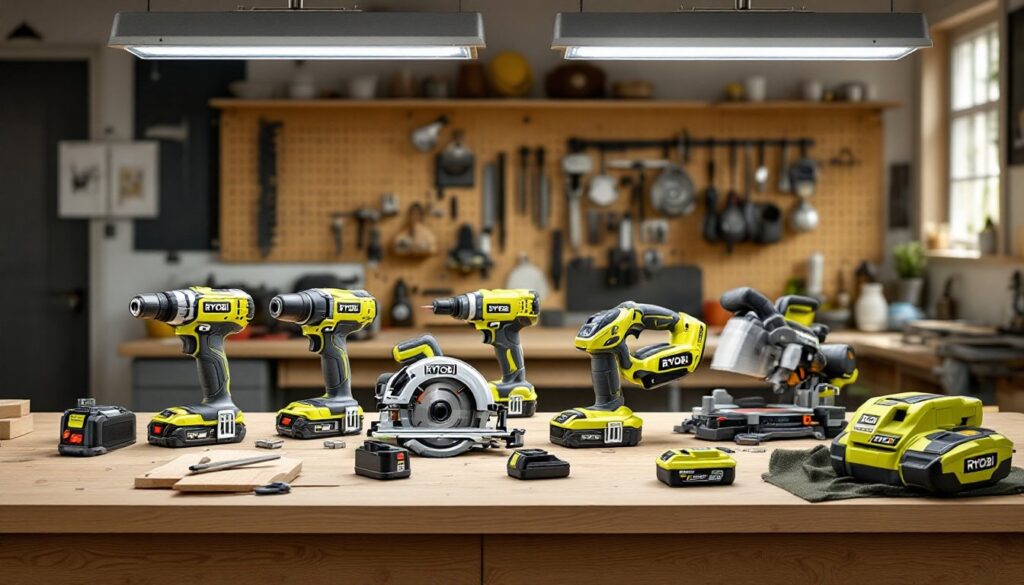
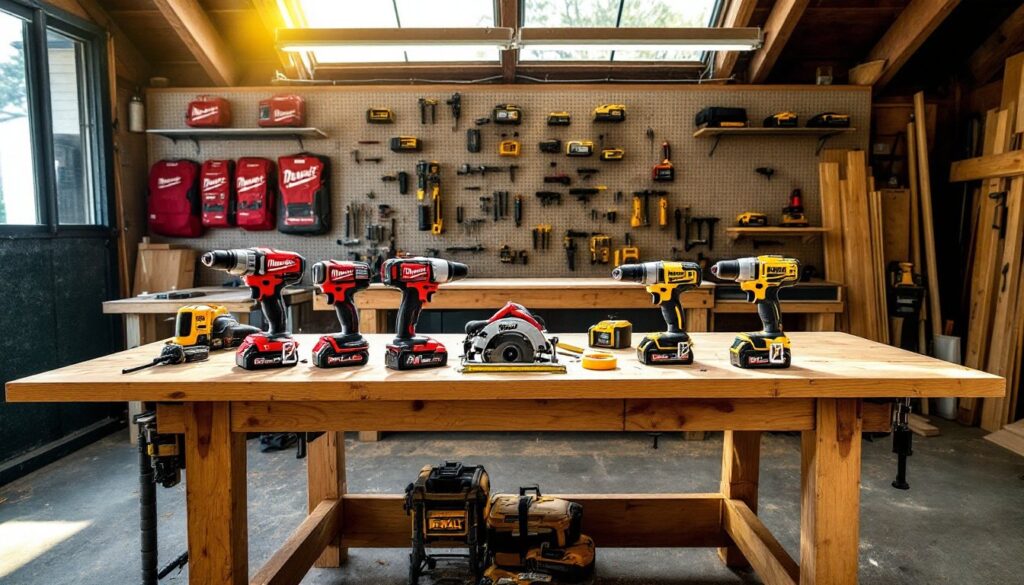
Cordless drill/driver sits at the top of every list for good reason. It handles everything from assembling furniture to hanging curtain rods to drilling pilot holes in framing lumber. Look for models with 18V or 20V batteries (different brands use different voltage standards for similar output) and two-speed settings, low speed for driving screws, high speed for drilling. Brushless motors cost more upfront but deliver longer runtime and lifespan.
Impact drivers use rotational hammering action to drive fasteners without stripping screw heads or tiring out wrists. They’re lighter and more compact than drill/drivers, making them ideal for overhead work or repetitive fastening. While a drill/driver can handle light fastening, anyone building a deck or framing a wall will appreciate the difference an impact driver makes.
Circular saw ranks as the most versatile cutting tool for straight cuts in dimensional lumber, plywood, and composite materials. A 7-1/4-inch blade cuts through a 2×4 at 45 degrees in one pass. Corded models deliver consistent power for demanding jobs: cordless versions offer mobility for roofing or outdoor projects. Either way, invest in a carbide-tipped blade designed for the material being cut, combination blades work for general purposes, but dedicated rip or crosscut blades perform better for specific tasks.
For those expanding beyond basic carpentry, having the right Workshop Tools and Equipment: builds a foundation for more complex projects.
Cutting and Shaping Power Tools
Once basic straight cutting is covered, precision cuts and specialty materials require more specialized tools.
Miter saw makes angled cuts for trim work, crown molding, and picture frames. A 10-inch compound miter saw handles most residential trim up to 5-1/2 inches wide when cutting 90-degree crosscuts. Sliding compound miter saws add front-to-back blade travel, increasing crosscut capacity to 12 inches or more, essential for wider materials like deck boards or stair treads. Detents at common angles (0°, 15°, 22.5°, 30°, 45°) speed up repetitive cuts.
Jigsaw cuts curves, circles, and intricate patterns in wood, plastic, laminate, and thin metal. It’s the tool for cutting sink openings in countertops or trimming door bottoms to clear new flooring. Orbital action (blade moves in an elliptical pattern) cuts faster but rougher: straight reciprocating action delivers cleaner edges. Use fine-tooth blades (10-12 TPI) for smooth cuts in finish materials, coarser blades (6 TPI) for fast rough cuts in framing lumber.
Reciprocating saw (often called a Sawzall, though that’s a Milwaukee brand name) demolishes framing, cuts through nails, and prunes tree limbs. It’s too aggressive for finish work but indispensable for remodeling, cutting PVC pipe, or removing old decking. Stroke length affects cutting speed, longer strokes (1-1/8 to 1-1/4 inches) cut faster in thick materials.
Table saw handles rip cuts (cutting boards lengthwise) more accurately and safely than a circular saw for larger projects. Jobsite saws with 10-inch blades provide adequate power and portability for most DIYers. A good fence system and miter gauge are critical for accuracy. Note that table saws account for significant workshop injuries, always use a push stick for narrow cuts and never reach over a spinning blade. Many jurisdictions don’t require permits for tool ownership, but if someone’s building structural elements, they may need inspections regardless of tools used.
Drilling and Fastening Power Tools
Beyond the basic drill/driver, specialized drilling and fastening tools increase speed and precision for specific applications.
Hammer drill combines rotary drilling with a pulsing hammering action, allowing it to bore into concrete, brick, and masonry. The hammer mechanism can usually be disengaged for standard drilling in wood or metal. For occasional concrete anchor installations, a hammer drill works fine. For regular masonry work, a rotary hammer (which uses a piston mechanism instead of clutch-based hammering) delivers more power with less user fatigue.
Right-angle drill fits into tight spaces where a standard drill can’t, between studs, floor joists, or inside cabinets. Electricians and plumbers use these constantly. The head typically measures 3 to 4 inches long, allowing drilling in a 14.5-inch stud bay (actual width of 16-inch on-center framing). Some models feature adjustable handles for better control in awkward positions.
Brad nailer drives 18-gauge brad nails (typically 5/8-inch to 2 inches long) for attaching trim, molding, and thin panels. Pneumatic models require an air compressor: cordless versions use battery power or fuel cells. Brad nails leave tiny holes that fill easily with wood putty, making them ideal for finish work. For heavier trim or situations requiring more holding power, a finish nailer shoots thicker 15 or 16-gauge nails up to 2-1/2 inches long.
Many Carpenter Tools: Essential include fastening systems that complement power nailers for professional-grade results. Similarly, anyone working on electrical projects should pair these tools with proper Electrical Tool Kits: Unlock to handle wiring safely.
Sanding and Finishing Power Tools
Surface preparation determines finish quality more than any other factor. Power sanders speed the process dramatically compared to hand sanding.
Random orbital sander combines circular pad rotation with random oscillating motion, preventing swirl marks while removing material quickly. It’s the go-to tool for smoothing tabletops, sanding painted surfaces between coats, and general finish work. 5-inch pads work for most tasks: 6-inch models cover more area but feel bulkier. Variable speed helps, start with lower speeds (8,000-10,000 OPM) for finish sanding, increase speed for paint removal.
Detail sander (or mouse sander, due to its shape) reaches into corners and tight spots with its triangular pad. Use it for sanding inside cabinet face frames, around window muntins, or along baseboards. They’re less aggressive than orbital sanders, making them suitable for delicate work.
Belt sander removes material fast, sometimes too fast. It’s excellent for leveling uneven boards, removing old finish from large flat surfaces, or smoothing rough-sawn lumber. Belt speed typically ranges from 1,000 to 1,500 feet per minute. Always sand with the grain and keep the sander moving to avoid gouging. For most DIYers, a 3×21-inch or 3×24-inch belt size balances power and control. Wear a dust mask or respirator when sanding, fine dust particles pose serious respiratory hazards, and many finish materials contain harmful substances. Sanders generate enormous amounts of dust, so work outdoors when possible or connect to a shop vacuum with a HEPA filter.
According to Popular Mechanics, proper dust collection extends tool life and improves finish quality by preventing dust from settling on freshly sanded surfaces.
Specialized Power Tools for Advanced Projects
As skills develop and projects become more ambitious, certain specialized tools transition from luxury to necessity.
Router shapes edges, cuts decorative profiles, hollows out areas (like hinge mortises), and creates joinery such as dadoes and rabbets. Plunge routers allow mid-surface cuts: fixed-base routers offer more precision for edge work and table mounting. Router bits come in hundreds of profiles, roundover, cove, ogee, chamfer, and rabbet bits handle most decorative and joinery tasks. Use 1/2-inch shank bits when possible: they’re more stable than 1/4-inch shanks and less prone to chatter. Routers spin at 20,000+ RPM, creating serious kickback if fed incorrectly, always move the router against the bit’s rotation (typically left to right on outside edges).
Biscuit joiner (or plate joiner) cuts crescent-shaped slots for wooden biscuits that align and strengthen edge joints, panel glue-ups, and miter joints. Biscuits come in standard sizes: #0, #10, and #20, with #20 being the most common for 3/4-inch material. While dowels, pocket screws, or dominos (a different system) can achieve similar results, biscuit joiners excel at panel alignment.
Oscillating multi-tool uses rapid side-to-side blade movement (up to 20,000 oscillations per minute) for flush-cutting, grout removal, caulk scraping, and detail sanding in tight spaces. It undercuts door jambs for new flooring, cuts drywall for electrical boxes, and removes old tile grout. The tool’s value lies in its versatility and ability to work in confined areas. Blades wear quickly on abrasive materials like tile or concrete, so budget for replacements.
Thickness planer reduces rough lumber to consistent thickness, allowing woodworkers to buy cheaper rough-sawn boards and mill them to project specs. Benchtop models handle boards up to 12 or 13 inches wide and remove up to 1/8 inch per pass. They create massive amounts of chips, so plan for collection or outdoor use.
Those working on metal fabrication or automotive projects should explore Mechanical Workshop Tools: Unlocking for complementary equipment options.
Outdoor and Yard Power Tools
Maintaining outdoor spaces requires a different set of power tools designed for weather exposure and heavier materials.
String trimmer (or weed whacker) edges along fences, sidewalks, and flower beds where mowers can’t reach. Gas models provide unlimited runtime and more power for thick weeds or brush: battery-powered versions run quieter with zero emissions. Bump-feed heads advance line by tapping the head on the ground: automatic-feed heads advance line as it wears. Shaft length matters, straight shafts reach farther and accept more attachments, while curved shafts feel more balanced for smaller users.
Leaf blower clears driveways, decks, and gutters. CFM (cubic feet per minute) measures air volume: MPH measures air speed. High CFM moves large piles: high MPH dislodges stuck debris. Backpack blowers distribute weight better for extended use. Some municipalities restrict gas blower use due to noise: check local ordinances. Resources like Family Handyman provide seasonal maintenance schedules that incorporate outdoor power tool usage.
Pressure washer removes mold, dirt, and old paint from siding, decks, driveways, and fences. PSI (pounds per square inch) measures pressure: GPM (gallons per minute) measures flow. 1,500-2,000 PSI handles most residential cleaning: 2,500-3,000 PSI tackles concrete and heavy staining. Too much pressure damages wood siding or strips deck finishes, use appropriate nozzles (25-40 degree tips for most surfaces) and maintain proper distance. Gas models deliver more power: electric versions suffice for light-duty work and cost less to maintain.
Chainsaw cuts firewood, removes fallen limbs, and fells small trees. Bar length determines maximum cutting diameter, a 16-inch bar cuts through a 14-inch diameter tree in two passes (one from each side). Gas chainsaws handle heavy cutting: battery models work for occasional limb removal. Chain tension, sharpness, and bar oil levels require regular attention. Always wear chainsaw chaps, gloves, safety glasses, and hearing protection, kickback injuries are severe. Tree felling exceeding certain diameters or near structures may require permits or licensed tree services depending on jurisdiction.
For general home maintenance tools beyond power equipment, consider reviewing Tools for Homeowners: Essential for a comprehensive toolkit baseline.
Conclusion
Building a power tool collection happens gradually, driven by actual project needs rather than speculative purchases. Start with the core drilling, driving, and cutting tools that handle most home repairs and improvements. Add specialized tools as skills develop and projects demand them. Quality matters more than quantity, one reliable circular saw outperforms three mediocre ones. Prioritize safety equipment alongside tools, maintain battery platforms within a single brand for cost efficiency, and don’t hesitate to rent expensive specialty tools for one-off projects. The right tool makes difficult work manageable and good work excellent.