
Table of Contents
ToggleRyobi’s bright green tools have become a staple in garages and workshops across the country, and for good reason. The brand hits a sweet spot that professional-grade tool lines often miss: solid performance at a price point that doesn’t require a second mortgage. For homeowners tackling weekend projects or DIY enthusiasts building out their first real workshop, Ryobi offers a battery platform that’s both extensive and affordable. This guide breaks down the standout tools worth buying in 2026, from cordless drills that’ll handle deck builds to lawn equipment that competes with gas-powered alternatives.
Key Takeaways
- Ryobi’s ONE+ battery platform powers over 280 tools with a single 18V battery, offering homeowners extensive options and backward-forward compatibility without juggling multiple battery types.
- Best Ryobi tools for most homeowners include brushless drills, impact drivers, circular saws, and miter saws that handle typical projects like decking, trim work, and furniture assembly at a fraction of premium brand costs.
- Ryobi’s 40V outdoor power tools—mowers, string trimmers, and leaf blowers—compete effectively with gas-powered alternatives while eliminating fuel mixing and carburetor maintenance.
- Brushless motors deliver superior longevity and efficiency compared to brushed models, making them worth the $20–$40 premium for frequently-used Ryobi tools.
- Combo kits ($250–$300) provide the most cost-effective entry point, bundling essential power drills, impact drivers, and batteries before adding specialized tools based on specific projects.
Why Ryobi Tools Are Perfect for Homeowners and DIY Enthusiasts
Ryobi operates in what tool enthusiasts call the “prosumer” category, above basic big-box store brands but below contractor-grade lines like Milwaukee or DeWalt. That positioning translates to real advantages for homeowners.
The ONE+ battery system remains Ryobi’s killer feature. A single 18V battery powers over 280 tools, from impact drivers to inflators to shop vacuums. Buy into the platform once, and you’re set for years of tool acquisitions without juggling multiple battery types. The batteries are backward and forward compatible, so a battery from 2015 still works in 2026 tools.
Price matters when you’re outfitting a workshop. Most Ryobi combo kits run $150–$300, compared to $400–$600 for equivalent Milwaukee or Makita sets. For a homeowner who might use a circular saw a dozen times a year rather than daily, that difference is substantial.
The trade-off? These aren’t demolition-site workhorses. Heavy daily use by professionals will wear out Ryobi tools faster than premium brands. But for typical home projects, building a fence, installing shelving, seasonal yard maintenance, they deliver years of reliable service. Most tools carry a three-year warranty, which covers typical homeowner use patterns.
Best Ryobi Power Drills and Drivers
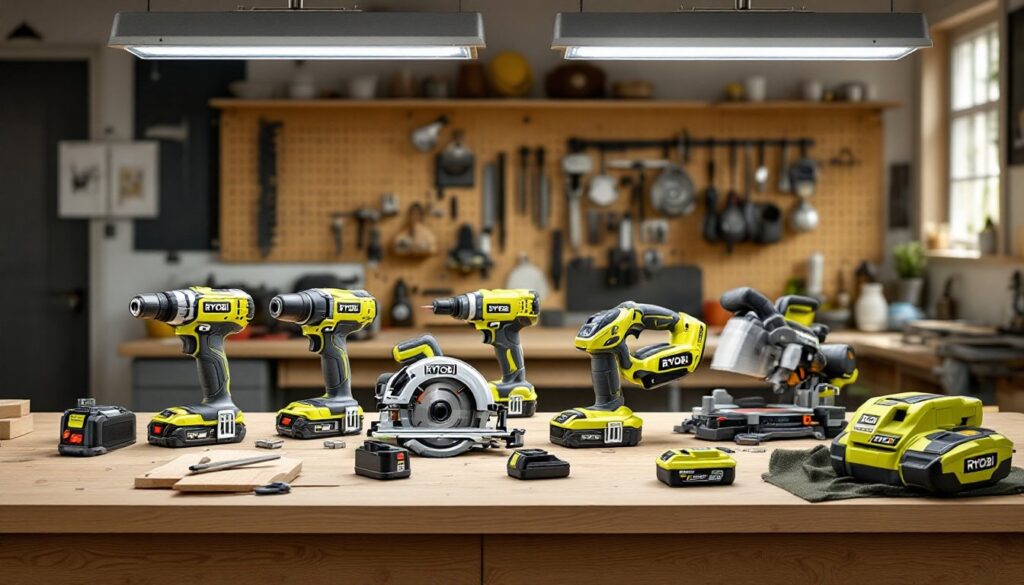
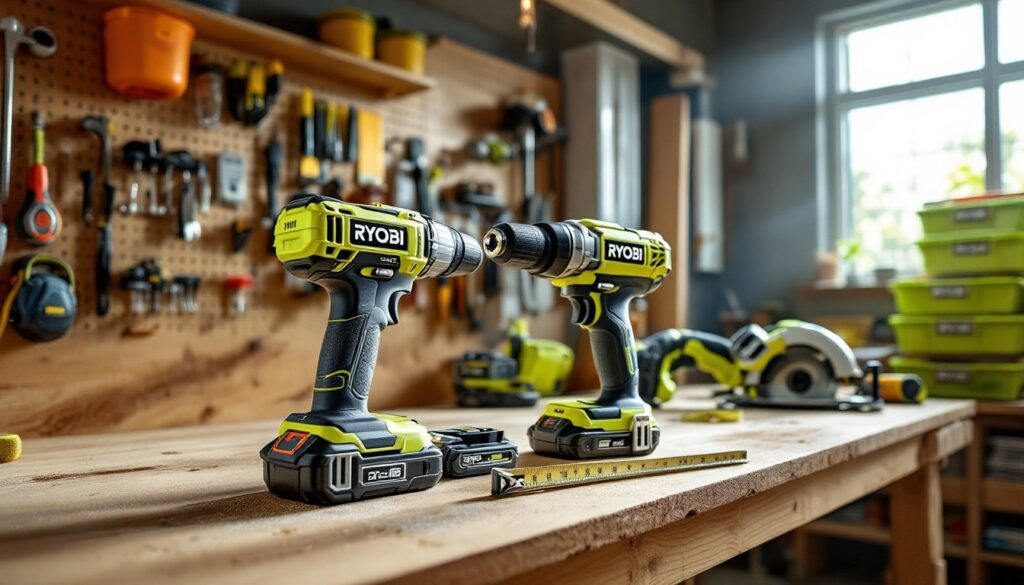
Ryobi HP Brushless Drill/Driver Kit
The HP (High Performance) Brushless Drill represents Ryobi’s step up from their basic drills. The brushless motor delivers 550 in-lbs of torque, enough to drive 3-inch deck screws through pressure-treated lumber without pre-drilling. The two-speed gearbox (0–550 and 0–2,100 RPM) handles both high-torque driving and faster drilling.
The 1/2-inch keyless chuck accepts standard bits, and the magnetic bit holder on the side keeps a spare driver bit handy. At 3.4 lbs with a 4Ah battery, it’s balanced enough for overhead work without causing arm fatigue.
Ryobi ONE+ Impact Driver
For repetitive fastening work, the ONE+ Brushless Impact Driver outperforms a standard drill. It generates 1,800 in-lbs of torque with minimal wrist strain thanks to the impact mechanism. The three-speed selector (0–1,100, 0–3,200, and 0–3,600 RPM) lets users dial back the power for finish work or smaller fasteners.
The quick-load 1/4-inch hex chuck accepts any impact-rated bit. LED work lights around the chuck illuminate tight spaces, a feature that seems minor until you’re working inside a cabinet or under a sink. Impact drivers excel at lag bolts, structural screws, and high-volume decking or framing projects where a drill would bog down.
Top Ryobi Saws for Home Projects
Ryobi 18V ONE+ Circular Saw
The ONE+ 6-1/2″ Circular Saw handles most cutting tasks a homeowner encounters. The smaller blade diameter (compared to the standard 7-1/4″) limits depth of cut to 2-1/8 inches at 90 degrees, which is sufficient for dimensional lumber up to 2x8s. It won’t cut through a 4×4 post in one pass, but you can flip the board.
The bevel capacity goes to 50 degrees, covering common angle cuts for roofing or trim work. Blade changes use a standard spindle lock. Many woodworking projects rely on accurate crosscuts, and this saw delivers when paired with a straight edge or speed square.
Ryobi 18V ONE+ Miter Saw
For trim carpentry or anyone cutting lots of molding, the 10-inch sliding compound miter saw in the ONE+ line runs on two 18V batteries (using Ryobi’s battery adapter). It crosscuts up to 12 inches wide at 90 degrees and 8-1/2 inches at 45 degrees.
The saw bevels 0–45 degrees left and miters 0–47 degrees in both directions. Dual slide bars provide stable support during cuts. The laser guide helps with cut placement, though some users prefer a conventional blade kerf indicator for precision. It’s not a replacement for a corded 12-inch compound miter saw in a professional cabinet shop, but it handles baseboard, crown molding, and deck board cuts without issue.
Best Ryobi Outdoor Power Tools
Ryobi 40V HP Brushless Self-Propelled Mower
Ryobi’s 40V platform powers their outdoor equipment line, separate from the 18V ONE+ system. The 21-inch self-propelled mower uses a brushless motor and handles typical suburban lawns up to half an acre on a single charge with two 6Ah batteries.
Self-propulsion reduces fatigue on sloped yards. Seven cutting height positions (1.5 to 4 inches) cover most turf types. The mower mulches, bags, or side-discharges. Runtime varies with grass height and density, but most users report 40–50 minutes of continuous mowing.
Ryobi 40V HP Brushless String Trimmer
The attachment-capable string trimmer in the 40V HP line accepts Ryobi Expand-It accessories, edger, pole saw, cultivator, and others. The brushless motor spins a 15-inch cutting swath, and the trimmer head loads easily with 0.080-inch line.
Variable speed control conserves battery around delicate plantings. The adjustable handle and shaft suit different user heights. A 4Ah battery provides roughly 30–40 minutes of runtime, depending on vegetation thickness. Professional landscapers still favor gas-powered commercial trimmers, but for typical lawn edging and fence line work, cordless models like this eliminate fuel mixing and carburetor maintenance.
Ryobi 40V HP Brushless Leaf Blower
The jet fan blower generates 730 CFM at 190 MPH, competitive with mid-range gas blowers. Turbo mode drains the battery faster but moves wet leaves and debris effectively. Standard mode extends runtime to about 20 minutes with a 6Ah battery.
The blower weighs under 10 lbs with battery, manageable for extended use. Noise levels sit around 65–70 dB, quieter than gas alternatives and compliant with most municipal noise ordinances. Seasonal cleanup tasks and workshop dust management are well within its capabilities.
Must-Have Ryobi Tools for Workshop and Storage
Ryobi ONE+ Wet/Dry Vacuum
The 6-gallon wet/dry vacuum runs on ONE+ batteries, eliminating cord management during workshop cleanup. It generates 40 CFM of suction, not shop-vac-corded-model levels, but adequate for sawdust, drywall dust, and water pickup after plumbing work.
The vacuum accepts standard 2-1/4-inch shop vac accessories and hoses. A 4Ah battery provides 15–20 minutes of runtime, enough for typical cleanup between cuts or after a day’s project. For extended use, keep a spare battery charged or use it near power for quick battery swaps.
Ryobi ONE+ Hybrid LED Work Light
Ryobi’s hybrid work lights run on batteries or plug into AC power. The 20-watt model puts out 2,000 lumens, enough to illuminate a garage bay or work area. Folding legs provide hands-free positioning, and the rotating head directs light where needed.
For tasks requiring consistent tool performance, proper lighting prevents mistakes and improves safety. The hybrid design means you’re not stranded when batteries die mid-project.
Ryobi Link Modular Storage System
The Link storage system uses stackable, interlocking tool boxes and organizers. Reinforced corners and metal latches survive truck bed transport. The system includes tool bags, small parts organizers, rolling tool boxes, and wall-mounted rails.
For homeowners who work across multiple locations, garage, yard, rental property, a modular system beats loose tool bags. Components connect securely and can be separated as needed for specific projects.
How to Choose the Right Ryobi Tool for Your Project
Start by identifying your most frequent tasks. If you’re hanging drywall and assembling furniture monthly, prioritize a quality drill and impact driver. Building decks or fences? Add a circular saw and miter saw. Large yard maintenance makes the 40V outdoor tools worthwhile.
Battery voltage matters. The 18V ONE+ platform covers most indoor power tools and light outdoor equipment. The 40V system handles demanding lawn care where runtime and power requirements exceed what 18V can deliver efficiently. Don’t mix platforms expecting cross-compatibility, they use different battery chemistries and voltages.
Brushless vs. brushed motors affect longevity and efficiency. Brushless motors run cooler, drain batteries slower, and last longer. They cost $20–$40 more per tool but pay off over time through extended battery runtime and reduced maintenance. For tools you’ll use frequently, choose brushless.
Consider combo kits when starting out. A typical 4-tool kit (drill, impact driver, circular saw, work light, two batteries, and charger) runs $250–$300, less than buying components individually. Add specialized tools as projects demand them.
Check if your project requires corded power. Battery tools have come far, but sustained high-power tasks like running a table saw all day or using a full-size miter saw on a job site still favor corded options. Ryobi makes corded versions of most tools for users who prioritize power over portability.
Recent testing by industry publications, including reviews in Popular Mechanics’ 2025 tool awards, confirms Ryobi’s position as a value leader. Their tools don’t always win performance shootouts against premium brands, but they consistently deliver the best performance-per-dollar ratio for homeowner use.
Conclusion
Ryobi’s tool lineup gives homeowners and DIY enthusiasts a practical path into cordless power tools without premium pricing. The ONE+ and 40V platforms cover everything from hanging pictures to building furniture to maintaining a half-acre property. Focus on the brushless models for frequent-use tools, start with a combo kit to establish your battery collection, and add specialized tools as your project list grows. The platform’s breadth means you’re investing in an ecosystem that’ll support decades of home projects.