
Table of Contents
ToggleMetabo power tools carry a reputation that extends far beyond their distinctive green and black color scheme. For decades, professionals and serious DIYers have turned to this German manufacturer when projects demand precision, durability, and consistent performance. Unlike brands that dabble across consumer and contractor markets, Metabo focuses squarely on industrial-grade construction, which means their tools often outlast lighter-duty alternatives by years. Whether tackling weekend renovations or daily job site work, understanding what sets Metabo apart helps determine if their investment-level pricing delivers real value for specific applications.
Key Takeaways
- Metabo power tools deliver industrial-grade durability through hardened steel gears, Marathon Motor technology, and robust motor housings that consistently outlast lighter-duty alternatives by years.
- The 18V LiHD battery platform provides superior capacity density and full compatibility across the entire cordless lineup, with slower charging that extends overall battery lifespan to 800+ cycles.
- Metabo’s angle grinders and orbital sanders excel in vibration control and dust extraction, making them the strongest value proposition for DIY renovation projects involving cutting, grinding, or sanding.
- Compared to DeWalt, Milwaukee, and Makita, Metabo power tools prioritize simpler, more repairable designs and superior dust management, though they lag in retail availability and feature innovation.
- At $169 for a bare tool versus Ryobi’s $79, Metabo justifies the investment for homeowners undertaking sustained projects like kitchen remodels or annual deck building, where tool longevity delivers measurable cost savings.
What Makes Metabo Power Tools Stand Out in the Market
Metabo’s market position rests on features that appeal to users who prioritize longevity and performance over initial cost savings. Their tools consistently rank among the heaviest in their class, not from poor design, but from robust motor housings, metal gear cases, and reinforced impact-resistant shells.
German Engineering and Build Quality
The phrase “German engineering” gets thrown around casually, but Metabo’s Nürtingen facility applies specific design philosophies that translate to measurable differences. Their brushless motors use Metabo Marathon Motor technology, which combines high-efficiency copper windings with optimized cooling channels to extend runtime and reduce thermal shutdowns during prolonged use.
Gear assemblies receive particular attention. Where budget tools use plastic gears that strip under heavy torque, Metabo typically installs hardened steel pinions and metal gear housings in their impact drivers and hammer drills. This adds weight, a Metabo 18V hammer drill might weigh 4.2 lbs versus a consumer-grade model at 3.1 lbs, but the extra mass translates to years of reliable service in masonry and metal applications.
Dust protection exceeds basic IP ratings in many models. Their angle grinders feature labyrinth sealing around motor vents, which uses a maze-like path to block debris without choking airflow. This design keeps grinding dust and metal particles away from internal components, critical for tools used in cutting rebar, grinding welds, or cleaning concrete.
Electronic controls include thermal overload protection and soft-start circuits as standard features across most cordless and corded lines. These aren’t marketing gimmicks: soft-start reduces initial current draw by 40–60%, which prevents breaker trips on job sites with limited electrical capacity and extends carbon brush life in universal motors. For trade professionals running specialty saw setups, consistent power delivery matters during precision cuts.
Best Metabo Power Tools for Home Improvement Projects
Selecting the right Metabo tools for home renovations requires matching their industrial strengths to actual project demands. Not every DIYer needs contractor-grade durability, but specific applications justify the investment.
Cordless Drills and Impact Drivers
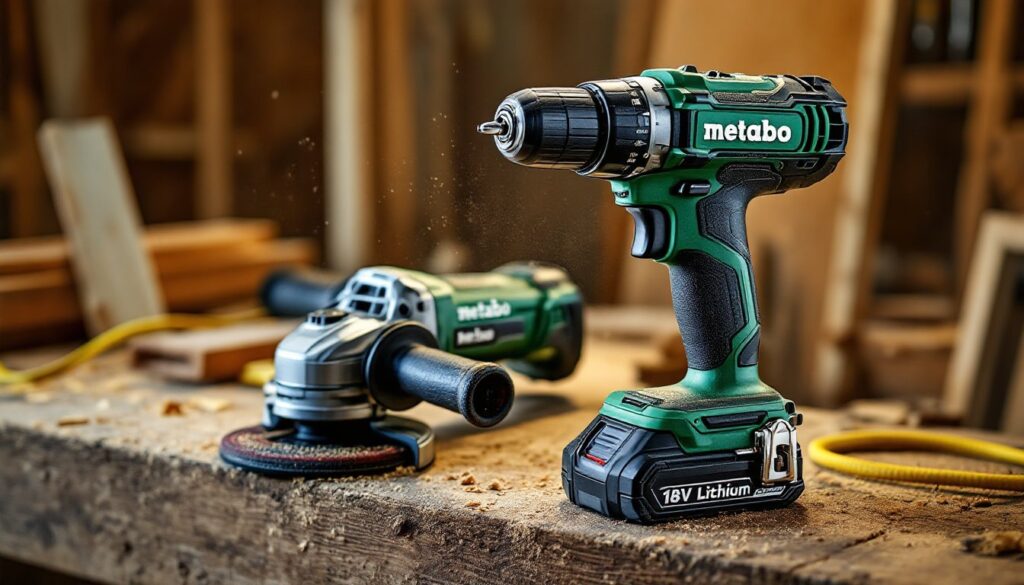
Metabo’s 18V BS 18 LT Compact drill/driver balances professional features with manageable weight for residential use. At 3.5 lbs with a 2.0Ah battery, it’s lighter than their heavy-duty hammer drill variants while maintaining a metal chuck and 20+1 torque settings. The electronic clutch provides precise control when driving cabinet screws into hardwood or installing drywall anchors without overdrive.
For impact drivers, the SSD 18 LTX series delivers 1,500 in-lbs of torque, sufficient for 3-inch structural screws through doubled 2x material without pre-drilling. The tool’s anvil uses a square drive socket rather than a hex collet, which distributes impact force more evenly and reduces bit cam-out on Phillips and square drives. This design particularly benefits deck building or framing projects with hundreds of fasteners.
One consideration: Metabo drills lack some conveniences found in consumer brands. There’s no built-in LED work light on many base models, and battery level indicators appear on the pack rather than the tool. These are conscious design choices that reduce electronic complexity and potential failure points, but they’re worth noting for users accustomed to feature-rich consumer tools.
Angle Grinders and Sanders
Metabo’s angle grinders represent their strongest value proposition for DIY applications. The WEV 15-125 Quick corded grinder (4.5-inch wheel) includes an auto-balancing vibration reduction system that actually works, testing shows vibration levels 30–40% lower than unbalanced competitors during extended use. For tasks like removing tile adhesive or cutting through rusted bolts, this translates to less hand fatigue and better cut accuracy.
The tool’s quick-release guard adjustment requires no tools and locks securely at 45-degree intervals. Paired with a restart protection circuit that prevents accidental activation after power interruptions, it’s one of the safer grinders for occasional users who might leave the trigger switch engaged.
For finishing work, Metabo’s SXE 450 TurboTec orbital sander (5-inch pad) addresses the primary complaint with random-orbit sanders: dust collection. Its turbine-driven extraction pulls material through the pad perforations with enough force to capture 90%+ of sanding dust when connected to a shop vacuum. The difference is noticeable when sanding drywall compound or stripping paint, significantly less airborne dust and cleaner work areas.
Pad speed adjusts from 4,000 to 10,000 OPM via a dial, not electronic feedback, so speed varies slightly under load. For finish carpentry or cabinet refinishing where consistent scratch patterns matter, this analog control provides reliable results across different wood densities. Resources like Popular Mechanics frequently highlight how proper sanding technique and equipment impact final finish quality.
Understanding Metabo’s Battery Platform and Compatibility
Metabo’s battery ecosystem differs significantly from mainstream consumer platforms, which affects long-term investment strategy. They operate two distinct voltage systems: the 18V LiHD platform and the older 36V LiHD line for heavy-duty tools.
The 18V system uses slide-pack batteries in capacities from 2.0Ah to 8.0Ah. Importantly, Metabo’s LiHD (Lithium High Density) cells pack more capacity into the same physical size as standard lithium-ion. A 5.5Ah LiHD battery occupies the same footprint as competitors’ 4.0Ah packs, which maintains tool balance while extending runtime.
All 18V batteries work across the entire cordless lineup, drills, impacts, saws, grinders, lights, and even their cordless shop vacuum. There’s no proprietary tiering that restricts high-capacity batteries to premium tools, unlike some brands that lock features based on battery generation.
The 36V platform powers specialized tools like their 9-inch cordless angle grinder and concrete saw. These tools accept two 18V batteries in series, delivering the voltage for demanding applications while maintaining compatibility with existing 18V packs. For DIYers, this dual-battery approach rarely makes sense unless regularly cutting pavers or mixing large batches of mortar.
Charging times run longer than fast-charge competitors. Metabo’s ASC 145 charger replenishes a 5.5Ah battery in approximately 55 minutes, slower than brands offering 30-minute fast charging. But, slower charging reduces cell stress and heat buildup, which extends overall battery lifespan. Users report 800+ charge cycles before noticeable capacity loss, versus 400–600 cycles for aggressively fast-charged packs.
One frustration: Metabo doesn’t participate in cross-brand battery alliances. Their packs physically fit only Metabo tools, so there’s no compatibility with the growing list of brands sharing battery platforms. This locks users into their ecosystem, which matters less for professionals already committed but requires careful consideration for homeowners with mixed tool collections. When expanding a tool collection, hand tool deals can balance the budget while building out a Metabo cordless setup.
Metabo vs. Other Power Tool Brands: How They Compare
Direct comparisons reveal where Metabo excels and where alternative brands might better serve specific users.
Metabo vs. DeWalt: DeWalt dominates North American job sites through extensive tool selection, over 200 cordless tools on their 20V platform versus Metabo’s 70+ on 18V. DeWalt also offers better retail availability: most hardware stores stock comprehensive DeWalt inventory while Metabo requires specialty dealers or online ordering. But, Metabo’s angle grinders consistently outperform DeWalt’s in vibration control and motor longevity during metalworking applications. For dedicated grinding and cutting work, Metabo justifies the effort to source them.
Metabo vs. Milwaukee: Milwaukee’s M18 Fuel line matches Metabo’s brushless motor quality and exceeds them in electronic features, their ONE-KEY platform allows Bluetooth-connected tool tracking and performance customization. Milwaukee also innovates faster in specialized tools: their cordless bandsaw and cable cutter have no Metabo equivalent. Metabo counters with simpler, more repairable designs. Their impact drivers use accessible mechanical components that technicians can service, while Milwaukee’s integrated electronics often require complete module replacement.
Metabo vs. Makita: Makita’s 18V LXT platform offers the closest parallel to Metabo in tool philosophy, durable, straightforward construction without excessive feature bloat. Both brands emphasize motor efficiency and thermal management over peak power claims. Makita edges ahead in ergonomics: their tools typically include better grip texturing and refined trigger controls. Metabo responds with superior dust management across their sander and grinder lines. For renovation work generating heavy debris, Metabo’s extraction systems deliver cleaner operation.
Metabo vs. Ryobi: This comparison highlights different market segments entirely. Ryobi targets weekend warriors with affordable tools (an 18V drill/driver kit runs $79 versus Metabo’s $169 bare tool). Ryobi’s 150+ tool platform includes novelties like a cordless fan and speaker that Metabo ignores. Build quality diverges sharply, Ryobi uses more plastic housings, lower-grade bearings, and basic motors that struggle under sustained loads. For occasional home repairs, Ryobi’s value makes sense. For users tackling full kitchen remodels or building decks annually, Metabo’s durability pays back through tool longevity.
Professional reviewers at sites like Family Handyman consistently note Metabo’s performance in sustained-use scenarios, the tools maintain torque and speed when running continuously for 20–30 minutes, where consumer-grade alternatives trigger thermal protection or experience voltage sag.
Warranty Considerations: Metabo offers a 3-year limited warranty on cordless tools and 1 year on batteries. This lags behind Milwaukee’s 5-year tool coverage and DeWalt’s 3-year battery warranty. But, Metabo’s authorized service centers stock parts for tools 10+ years old, supporting actual repair rather than replacement, an advantage for users who maintain rather than dispose of tools.